Showing posts with label Music. Show all posts

Friday, December 10, 2021

GOD IN US

1965
 

Joan Baez performing the song God Is God at the Chautauqua Auditorium in Boulder, CO on 7/15/09.

God Is God

I believe in prophecy.
Some folks see things not everybody can see.
And, once in a while, they pass the secret along to you and me.

And I believe in miracles.
Something sacred burning in every bush and tree.
We can all learn to sing the songs the angels sing.

Yeah, I believe in God, and God in me.

I've traveled around the world,
Stood on mighty mountains and gazed across the wilderness.
Never seen a land with sand or a diamond in the dust.

And as our fate unfurls,
Every day that passes I'm sure about a little bit less.
Even my mommy tells me it's God I need to trust.

And I believe in God, and God in us.

God, of my little understanding, don't care what name I call.
Whether or not I believe doesn't matter at all.
I receive the blessings.
That every day on Earth's another chance to get it right.
Let this little light of mine shine and rage against the night.

Just another lesson:
Maybe someone's watching and wondering what I got.
Maybe this is why I'm here on Earth, and maybe not.

But I believe in God, and God is God.

Source: LyricFind
Songwriters: Steve Earle
 
2020
Joan Baez portrait of Kamala Harris

“Kamala, you have reintroduced the concept of what should have long been a constant in our lives: The beloved community,” Joan says. “What a joy to see your face as you cheerfully bring compassion and empathy, decency, and bravery - the virtues which should define us as a people - back into our discourse and our lives.” 


Tuesday, August 10, 2021

MUSIC & POETRY

Barb has provided us with one of her poems which touches on her experience of music bringing together the explicit and implicit worlds. In the book I am reading, The Master and His Emissary, by Iain McGilchrist, I find that he has shown how the right hemisphere of the brain contributes to our ability to discern in music and poetry the implicit world which is opaque to the left hemisphere which attends to the explicit world. Barb's poem begins with the explicit - the contract, time consciousness, empty seats. Playing the music begins the transition to a different type of experience where the Wedding integrates all into a whole which is more than the sum of the parts.

The Master and His Emissary, Page 72
 
(M)usic is the natural candidate for the concerns of the right hemisphere. It is the relations between things, more than entities in isolation, that are of primary importance to the right hemisphere. Music consists entirely of relations of 'betweenness.' The notes mean nothing in themselves; the tensions between notes, and between notes and the silence with which they live in reciprocal indebtedness, are everything. Melody, harmony and rhythm each lie in the gaps, and yet the betweenness is only what it is because of the notes themselves. Actually the music is not just in the gaps any more than it is just in the notes: it is the whole that the notes and silence make together. Each note becomes transformed by the context in which it lies. What we mean by music is not just any agglomeration of notes, but one in which the whole created to make each note live in a new way, a way that it had never done before. Similarly poetry cannot be just any arrangement of words, but one in which each word is taken up into a new whole and made to live again in a new way, carrying us back to the world of experience, to life: poetry constitutes a 'speaking silence.' Music and poetic language are both part of the world that is delivered by the right hemisphere, the world characterized by betweenness. Perhaps it is not, after all, not so wide off the mark to call the right hemisphere the 'silent' hemisphere: its utterances are implicit."   

The two hemispheres of the brain complement each other. Singing provides the left half of the brain with words which it's language skills use to add another dimension to the enjoyment.

King's Singers - In the Real Early Morning

"In the real early morning

With the sun slowly rising
I was walking out slowly
Wandering free
When out in the distance
Over the valley
I saw an old friend
Waiting for me
Waiting for me

She was a young girl
She was an old soul
As fair as the ocean
Timeless and free
She was my mother
She was my daughter
She was my lover
She was everything
An old friend could be

I said it's been such a long time
Since we have spoken
There's so much to say to you
I want you to know
Wish you could tell me
All that you've seen here
But we haven't got long now
For soon you'll be fading
And soon I must go

She said you are a soldier
You are a father
You are a wise man
You are a friend
You were my first love
I won't forget you
I'm walking beside you
I was here when you started
I'll be here till the end

And now it's evening
There's a moon slowly rising
There isn't much more that
I wanted to know (wanted to know)

And I am alone now
She isn't beside me no more
But I feel no sorrow
I'll come tomorrow

I'll be on my way home

Source: Musixmatch

Songwriter: Jacob Collier


Friday, July 23, 2021

REALIZING THE DREAM

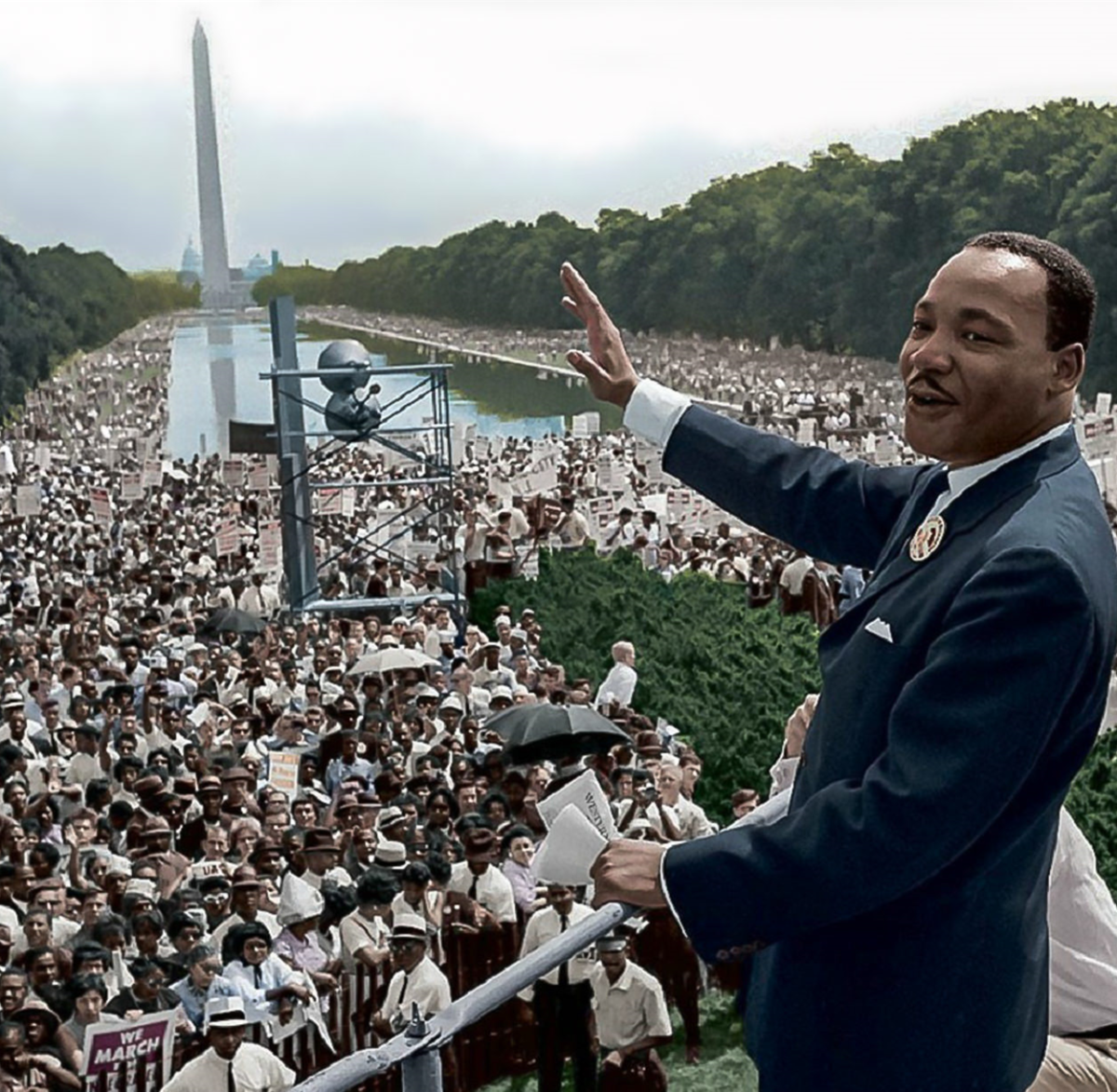
March on Washington
Martin Luther King
1963

I Have a Dream excerpt from speech delivered from Lincoln Memorial:

"I say to you today, my friends, though, even though we face the difficulties of today and tomorrow, I still have a dream. It is a dream deeply rooted in the American dream. I have a dream that one day this nation will rise up, live out the true meaning of its creed: “We hold these truths to be self-evident, that all men are created equal.”I have a dream that one day on the red hills of Georgia sons of former slaves and the sons of former slave-owners will be able to sit down together at the table of brotherhood. I have a dream that one day even the state of Mississippi, a state sweltering with the heat of injustice, sweltering with the heat of oppression, will be transformed into an oasis of freedom and justice. 

I have a dream that my four little children will one day live in a nation where they will not be judged by the color of their skin but by the content of their character. I have a dream . . . I have a dream that one day in Alabama, with its vicious racists, with its governor having his lips dripping with the words of interposition and nullification, one day right there in Alabama little black boys and black girls will be able to join hands with little white boys and white girls as sisters and brothers. I have a dream today ." 


If we are open to listening and seeking new experience we are often led in unexpected and surprising directions. When seeking performances by The King's Singers I came across a meditative video which included in the title Bono/U2 arr. Bob Chilcott - MLK.

This is the legend for the recording: "To mark Martin Luther King Day 2018, The King's Singers took a few minutes to record their cover of this song, MLK, by Bono from the band U2. The arrangement is by Bob Chilcott, former tenor in The King's Singers, and it was recorded during in L'Oratoire du Louvre, Paris."

So my next step was to check out Bono and the connection to Martin Luther King.

These are the simple words of the song:
 
"Sleep
Sleep tonight
And may your dreams
Be realized

If the thundercloud

Passes rain
So let it rain
Rain down on him
Mmm
So let it be
Mmm
So let it be

Sleep

Sleep tonight
And may your dreams
Be realized
If the thundercloud
Passes rain
So let it rain
Let it rain
Rain on him"

Source: LyricFind
Songwriters: Adam Clayton / Dave Evans / Larry Mullen / Paul Hewson [Bono]
 
I found this tribute to King from Bono:

“Dr. King kept us tolerant in a time of terror,” Bono says during his 10-minute tribute. “Kept us faithful to peace and community. Made us believe in joy and justice. Showed us the way to a shared humanity. Dr. King’s voice is louder today than it has ever been. He is one of the true fathers of our American dream.”

Now I wanted to know more about Bono and U2. Searching on Wikipedia through his biography and career as a pop singer, I learned that a tour which the group made in 2014-15 was named Songs of Innocence. The next tour 2017 they named Songs of Experience. A combined Innocence and Experience tour took place in 2018. I needed to know more about the connection of Bono with William Blake who wrote his illuminated poetry titled Songs of Innocence and of Experience in the late 18th century.

Here is what Bono had to say in an Interview with Rolling Stones:

What are the common themes that tie the songs on Songs of Experience together?
I try not to talk about William Blake too much because it sounds pretentious quoting such a literary giant but it was his great idea I pinched to compare the person we become through experience to the person who set out on the journey. If you’re talking about innocence, you’ve probably already lost it but I do believe at the far end of experience, it’s possible to recover it with wisdom. I’m not saying I have much of that but what little I have, I wanted to cram into these songs. I know U2 go into every album like it’s their last one but even more this time I wanted the people around me that I loved to know exactly how I felt. So a lot of the songs are kind of letters, letters to Ali [wife], letters to my sons and daughters, actually our sons and daughters.
...
And one that I didn’t realize until too late that I was writing to myself, “It’s the Little Things Give You Away.” In all of these advice type songs, you are of course preaching what you need to hear. In that sense, they’re all written to the singer. One other piece on Blake, I don’t know if I’m explaining too much here but the best songs for me are often arguments with yourself or arguments with some other version of yourself. Even singing our song “One,” which was half fiction, I’ve had this ongoing fight. In “Little Things,” innocence challenges experience: “I saw you on the stairs, you didn’t notice I was there, that’s cause you were busy talking at me, not to me. You were high above the storm, a hurricane being born but this freedom just might cost you your liberty.”

At the end of the song, experience breaks down and admits his deepest fears, having been called out on it by his younger, braver, bolder self. That same conversation also opens the album with a song called ”Love Is All We Have Left.” My favorite opening line to a U2 album: “There’s nothing to stop this being the best day ever.” In the second verse, innocence admonishes experience: “Now you’re at the other end of the telescope, seven billion stars in her eyes, so many stars so many ways of seeing, hey, this is no time not to be alive.” It’s a chilling moment – in the chorus I was pretending to be Frank Sinatra singing on the moon, a sci-fi torch song “love, love is all we have left, a baby cries on the doorstep, love is all we have left.”

William Blake
Songs of Innocence 
Little Black Boy

Bono quote from the LA Times:

“Songwriting comes from a different place,” he continues. “Music is the language of the spirit. I think ideas and words are our excuse as songwriters to allow our heart or our spirit to run free. That’s when magic happens.”

Dreams, too, come from a different place. We don't own them; they are shared. But the dream of freedom, equality and justice is implemented in individual ways by individuals. Each of us becomes a part of the dream in the way that it can be expressed through us.


Saturday, July 17, 2021

SIMPLE GIFTS

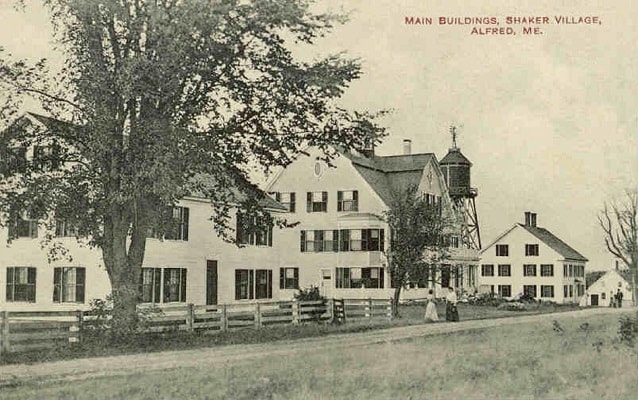
Alfred Shaker Village
Alfred Maine
1915 Postcard

A favorite hymn among Quakers is a Shaker hymn written in 1848. The writer and composer is said to be Elder Joseph Brackett of the Alfred Village in Maine.

'Tis the Gift to be Simple

Original Shaker Hymn
1
Tis the gift to be simple, 'tis the gift to be free,

'Tis the gift to come down where we ought to be,
And when we find ourselves in the place just right,
'Twill be in the valley of love and delight.
REFRAIN
When true simplicity is gain'd,
To bow and to bend we will not be asham'd,
To turn, turn will be our delight,
Till by turning, turning we come round right


Additional verses in Worship in Song - A Friends Hymnal
2 -
'Tis the gift to be gentle,'tis the gift to be fair,
'Tis the gift to wake and breathe the morning air.
To walk every day in the path we choose.
'Tis the gift we pray we will never, never lose.
REFRAIN
3
Tis the gift to be knowing, 'tis the gift to be kind,
'Tis the gift to wait to hear another's mind,
That when we speak our feelings we might come out true,
'Tis the gift for me and the gift for you.
REFRAIN
4
'Tis the gift to be loving, 'tis the best gift of all,
Like the warm spring rain bringing beauty when it falls,
And as we use this gift we might come to believe,
'Tis better to give than it is to receive.
REFRAIN

'Tis the Gift to be Simple was not well know outside of Shaker circles until in 1944 the tune was incorporated by Arron Copland in the ballet score he wrote for Martha Graham. Since Shakers used dance in their worship, it was apropos that the Shaker hymn be performed as ballet in Appalachian Spring. In 1963 Sydney Carter adapted the tune for Lord of the Dance which was prominent in the dance musical Lord of the Dance first performed in 1996.

Barack Obama's 2009 inauguration as president included a quartet
Air and Simple Gifts composed by John Williams and based on the Shaker hymn. The moving performance by Anthony McGill (clarinet), Itzhak Perlman (violin), Yo-Yo Ma (cello) and Gabriela Montero (piano) made that inauguration the only one that sticks in my memory. (I do also remember Jimmy Carter and Rosalynn getting out of their limousine and walking along Pennsylvania Avenue to the White House.) 

Although the Shaker faith developed out of Quakerism it deviated from Quaker practice in many ways. Shakers practiced a communal lifestyle, they were organized under a hierarchical system, they practiced celibacy and they followed a strict set of rules. Although there were once nineteen Shaker communities scattered among at least six states with as many as 500 members each, they gradually had to close their communities for lack of membership. 

The memory of the Shaker experiment in radical Christianity is kept alive by their music, their furniture and the remnants of their communities left behind.

More music:

The songs and dances included are: The Humble Heart; Simple Gifts; Love, Love, Love; Father James' Song; Come Dance and Sing; Now My Dear Companions; A People Called Christians; I Am a Brave Soldier; Step Tune; A Cup of Rejoicing; Lay me Low; My Carnal Life I will Lay Down; Dismission of the Devil; Primitive Dance Tune; An Indian Song; When Cheer Fills the Hearts; Shuffling Song; Shepherdess Song.


National Parks Service
History of the Shakers


Friday, May 14, 2021

REMEMBER WHEN

The Attack by Edvard Isto
Symbolizes Finland's Resistance to Russification

Finlandia was composed in 1899-90 by Jean Sibelius as a patriotic symphonic poem.  

Article by Danny Riley

"Press censorship was a strong characteristic of Russian, and in 1899 Sibelius was asked to compose some music for a “Press Celebrations” event. It was advertised as a fundraiser for pensions of newspaper workers, but its real purpose was to help finance a Finnish free press. So, to mark the occasion Sibelius chose to create a set of seven musical tableaux depicting momentous occasions in his country’s history."
...
"The work ended, however, in the rousing “Finland Awakes” – an optimistic look towards the country’s future."
...
"As the work grew in popularity, however, it had to be performed under politically inoffensive pseudonyms to avoid Russian censorship."
...
"When the Finnish parliament declared independence from Russia in December 1917, this feeling was crystallised in the music of Finlandia. “We fought 600 years for our freedom and I am part of the generation which achieved it,” he wrote. “Freedom! My Finlandia is the story of this fight. It is the song of our battle, our hymn of victory.” From then on, Finlandia remained a constant source of inspiration for patriotic Finns, with the poet Veikko Antero Koskenniemi writing his own lyrics to the 'Finlandia Hymn' in response to Russian aggression during the Second World War." 
 
*****

The words of the hymn Be Still, my soul were written in 1752 in German by Katharina von Schlegel and translated to English by Jane Borthwick in 1855. It is sung to Sibelius' tune Finlandia.

Be Still My Soul 

1 Be still, my soul! for God is on your side;
bear patiently the cross of grief or pain:
leave to your God to order and provide,
who through all changes faithful will remain.
Be still, my soul! your best, your heav’nly Friend
through thorny ways leads to a joyful end.

2 Be still, my soul! for God will undertake
to guide the future surely as the past.
Your hope, your confidence, let nothing shake;
all now mysterious shall be clear at last.
Be still, my soul! the waves and winds still know
the voice that calmed their fury long ago.

3 Be still, my soul! the hour is hastening on
when we shall be forever in God's peace;
when disappointment, grief, and fear are gone,
love’s joys restored, our strivings all shall cease.
Be still my soul! when change and tears are past,
all safe and blessed we shall meet at last.

*****

In 1932 a young music student at the University of Southern California aware that the great powers were once again threatening to take control of weaker nations, felt in Sibelius' powerful music a way to speak out for peace. Lloyd Stone wrote his own words to the tune Finlandia.

A Song of Peace

This is my song
Oh God of all the nations
A song of peace for lands so far away
This is my home, a country where my heart is
Here grew my hopes and dreams for all mankind
But other hearts in other lands are beating
With hopes and dreams as true and high as mine

My country's skies are bluer than the ocean
And sunlight shines on clover leaf and pine
But other lands have sunlight too and clover
And skies are everywhere as blue as mine
Oh hear my prayer, o gods of all the nations
A song of peace for their lands and for mine

"Lloyd Stone (1912 – 1993) was born in California and attended the University of Southern California as a music major, with the intent of becoming a teacher. Instead, he joined a circus bound for Hawaii and remained there for the rest of his life, writing poems and songs. This is his best known work; stanzas 1 and 2 were written in 1934 when Lloyd was 22 years old. Often combined with several additional verses by Georgia Harkness, the poem is typically sung to the tune Finlandia, composed by Jean Sibelius. Lloyd also wrote a musical based on Joyce Kilmer’s poem, 'Trees,' and several books of Hawaii-themed poems. Said one reviewer, '[Stone] does not sing of the palms and the surf, but of the earthy human beauty which is the heritage of the islands.'"

*****

I remember when we sang together the hymn A Song of Peace, page 304 in our Friends Hymnal. 


Tuesday, May 4, 2021

PENN SCHOOL

Library of Congress, Prints and Photographs
Significant Election Scene at Washington, June 3, 1867

From the earliest days of Quakerism there has been a two pronged thrust of Quaker activities: to make people aware of the Divine Presence within everyone, and to help those who were who were oppressed. In the early days of the Civil War Pennsylvania Quakers saw an opportunity to help the freed slaves on St Helena Island in South Carolina make the transition to freedom. An organization named Friend's Freedmen's Association of Philadelphia provided volunteers and donations of money, clothing and supplies.

Although the rebellious southern states were in the hands of the Confederacy, the sea Islands had been captured during the Battle of Port Royal on November 7, 1861 and remained in the hands of Union troops for the duration of the war. The plantation owners and their families escaped the islands leaving behind their thousands of slaves. Two of the women who saw the need to provide assistance to the freed slaves were Laura Townes, a Unitarian from Philadelphia, and her friend Ellen Murray a Quaker from Rhode Island. They are credited with establishing the first school for freed slaves. When in 1864 the Freedmen's Association of Philadelphia provided a prefabricated building as the first permanent location, the school acquired the name Penn School in gratitude to their supporters in Pennsylvania. For Laura Townes and Ellen Murray assisting the community of Gullahs in the area around St Helena Island became their life's work. Their programs included education for children and adults, health care and helping establish self sustaining agricultural practices. 

Ellen Murray & Students
c. 1890 

The African Americans on St Helana Island were distinctive in being from a group called Gullahs who retained their own language and many of their customs. Since the land had been abandoned by the plantation owners, the military distributed it among the blacks who had served the whites and produced the crops of indigo, rice, cotton and spices. Although the African Americans were later given title to land, policies changed and title was often not secure. 

Rev. Jesse Jackson, Joan Baez, Ira Sandperl, Dr. Martin Luther King, Jr., and Dora McDonald on the Penn Center campus in 1964

As the needs of the people changed the programs offered by what became the Penn Center evolved. To secure an economic base for the community, education began to focus on agriculture, industry and practical skills. In the 1960's the center provided space for interracial activities which were prohibited elsewhere. More recently the Penn Center has emphasized making it possible for Gullah families to keep the land which has been hands for over a hundred years. Large scale development in the Sea Islands and changes to legal requirements for ownership have threatened the Gullah people with removal. More recently the Penn Center has become involved with the National Park service in the establishment of the Reconstruction Era National Historical Park.


Gullah Music

Gullah Roots


Saturday, April 17, 2021

WALLS WE BUILD

 I knew Sally had a sister who lives in New Orleans and who has one of the amazing stories to tell about surviving Hurricane Katrina, but I had never met her. A while back I learned that Sally's sister has a blog titled angels and people, life in New Orleans. It takes very little time to follow this blog because several times a week she will post a photograph which she has recently taken, along with a title which may suggest what she sees in it. I am grateful for the connection I discovered with Susanna through Sally.

This I found particularly moving: Figure By Mount Olivet Cemetery fence

  I try to hold this picture in my consciousness as reminder that we have built a wall between our comfortable, middle class existence and the lives of those whom we have excluded and denied opportunities because of race, class or traditional barriers. The walls will not fall of their own accord nor can they be removed by those who are imprisoned by them. We who built them, benefit by them, and who keep them in repair to protect ourselves, must be the ones who remove them.

History of a Slave Songbook.


Friday, February 12, 2021

MOMENT TO DECIDE

James Russell Lowell

The hymn Once to Every Soul and Nation can be found on page 273 of Worship in Song: A Friends Hymnal. It was written by the nineteenth century poet James Russell Lowell in response to a request from his friend and fellow abolitionist John Greenleaf Whittier who wrote to him: "Give me one that shall be to our cause what the song of Rouget de Lisle was to the French Republicans." Lowell wrote an eighteen verse poem with the title The Present Crisis.

Although Lowell's words were not destined to have as great an influence as "La Marsellaise" had for France, it contributed significantly to the antislavery movement when it was written, and to the civil rights movement a hundred years later. It's original goal was to oppose the annexation of Texas as a state allowing slavery. Lowell  believed that through his poetry he could play a role as a prophet and critic of society. In the twentieth century the poem become a source for quotations in the speeches and sermons of Martin Luther King, Jr.


Tuesday, January 26, 2021

AMONG THE TREES

Thanks to Susan C for this post including the picture.

This morning at Meeting for Worship in the Woods, in looking up at the trees, I was reminded of this poem by Mary Oliver, particularly the phrases of our having "come into the world to do this, to go easy, to be filled with light, and to shine" speak to me. These woods and words are sacred. They have helped to save me during pandemic.

When I am Among the Trees

                                                by Mary Oliver
When I am among the trees,
especially the willows and the honey locust,
equally the beech, the oaks and the pines,
they give off such hints of gladness.
I would almost say that they save me, and daily.

I am so distant from the hope of myself,
in which I have goodness, and discernment,
and never hurry through the world
but walk slowly, and bow often.

Around me the trees stir in their leaves
and call out, “Stay awhile.”
The light flows from their branches.

And they call again, “It's simple,” they say,
“and you too have come
into the world to do this, to go easy, to be filled
with light, and to shine.”


I am reminded of a song I heard long ago at summer camp: Green Cathedral.  The words are by Gordon Johnstone, the music by Carl Hahn.


Saturday, January 23, 2021

IN THY HAND

Earlham School of Religion
Richmond, Indiana

Recently at Meeting for Worship Gary recalled the words of a hymn he sang when he was a student at Earlham School of Religion. He remembered these words from the hymn:

Lord they’ll hast searched me and dost know 

Where I rest, where e're I go
Thou knowest all that I have planned
All my ways are in thy hand.

For the Thou didst form my inner parts
Thou didst knit me together in my mothers womb

Where can I go apart from thee?
Whither from thy presence flee?
Heav'n it is thy dwelling fair
E'en in death Lord, thou art there

The hymn quotes words from Psalms 139.

[1] O LORD, thou hast searched me, and known me.
[2] Thou knowest my downsitting and mine uprising, thou understandest my thought afar off.
[3] Thou compassest my path and my lying down, and art acquainted with all my ways.
[4] For there is not a word in my tongue, but, lo, O LORD, thou knowest it altogether.
[5] Thou hast beset me behind and before, and laid thine hand upon me.
[6] Such knowledge is too wonderful for me; it is high, I cannot attain unto it.
[7] Whither shall I go from thy spirit? or whither shall I flee from thy presence?
[8] If I ascend up into heaven, thou art there: if I make my bed in hell, behold, thou art there.
[9] If I take the wings of the morning, and dwell in the uttermost parts of the sea;
[10] Even there shall thy hand lead me, and thy right hand shall hold me.
[11] If I say, Surely the darkness shall cover me; even the night shall be light about me.
[12] Yea, the darkness hideth not from thee; but the night shineth as the day: the darkness and the light are both alike to thee.
[13] For thou hast possessed my reins: thou hast covered me in my mother's womb.
[14] I will praise thee; for I am fearfully and wonderfully made: marvellous are thy works; and that my soul knoweth right well.
[15] My substance was not hid from thee, when I was made in secret, and curiously wrought in the lowest parts of the earth.
[16] Thine eyes did see my substance, yet being unperfect; and in thy book all my members were written, which in continuance were fashioned, when as yet there was none of them.
[17] How precious also are thy thoughts unto me, O God! how great is the sum of them!
[18] If I should count them, they are more in number than the sand: when I awake, I am still with thee.
[19] Surely thou wilt slay the wicked, O God: depart from me therefore, ye bloody men.
[20] For they speak against thee wickedly, and thine enemies take thy name in vain.
[21] Do not I hate them, O LORD, that hate thee? and am not I grieved with those that rise up against thee?
[22] I hate them with perfect hatred: I count them mine enemies.
[23] Search me, O God, and know my heart: try me, and know my thoughts:
[24] And see if there be any wicked way in me, and lead me in the way everlasting.

Although there are several versions of the Hymn on youtube, none exactly matches the version which Gary sang at Earlham. However the the hymn is included in our Quaker Hymnal, Worship in Song, on Page 210. The note in back of the hymnal states: "A close paraphrase of Psalm 139:1-12, by an anonymous author, set to an old shape-note hymn tune [Tender Thought] which is almost pentatonic except for A flat in the sixth measure. This is one of the tunes from the Kentucky Harmony, published by Ananias Davisson in Harrisonburg, Virginia, in 1815."

These are the words from Worship in Song:

1 Lord, thou hast searched me and dost know
Wherever I rest, wherever I go;
Thou knowest all that I have planned,
And all my ways are in thy hand.

2 My words from thee I cannot hide;
I feel thy power on every side;
O wondrous knowledge, awesome might,
Unfathomed depth, unmeasured height!

3 Where can I go apart from thee,
Or whither from thy presence flee?
In heaven? It is thy dwelling fair;
In death's abode? Lo, thou art there.

4 If I the wings of morning take,
And far away my dwelling make,
The hand that leadeth me is thine,
And my support thy power divine.

5 If deepest darkness cover me,
The darkness hideth not from thee;
To thee both night and day are bright,
The darkness shineth as the light.

This verse is included in the Trinity Psalter Hymnal:

6 Within the womb you knitted me
so fearfully and wondrously;
I give my maker thankful praise,
whose wondrous works my soul amaze.

I look forward to soon singing Lord, Thou Hast Searched Me at meeting after Gary teaches it to us.

Listen to a group of Mennonites singing this hymn. 


Wednesday, November 18, 2020

GATHERED MEETING

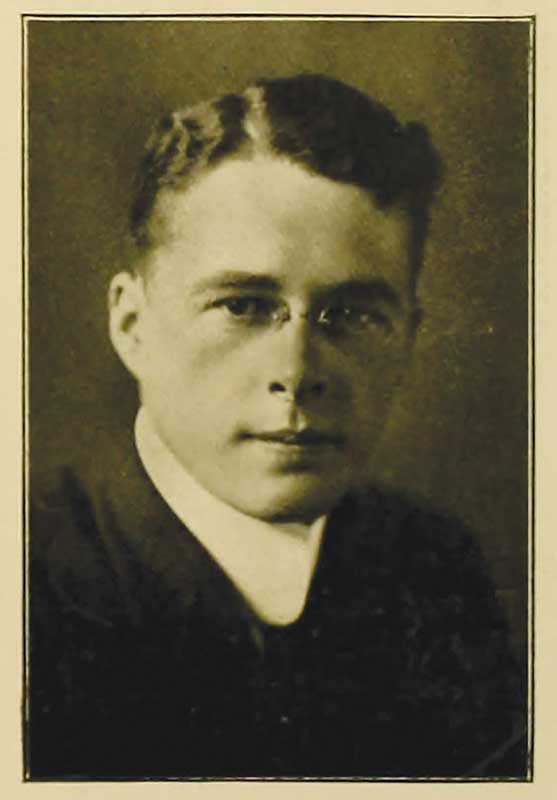
Thomas Kelly, 1914
Friends Journal
Courtesy of Haverford College

Thomas Kelly, a Quaker mystic, wrote this passage which was published in a tract available on the internet. Thomas Kelly, a birthright Quaker, lived from 1893 until 1941. He is best know as an author and professor of philosophy at Haverford College. 

The Gathered Meeting 

"The crux of religious living lies in the will, not in transient and variable states. Utter dedication of will to God is open to all, for every man can will. Where such a will is present, there is a child of God. When there are graciously given to us such glimpses of glory as aid us in softening our will, then we may be humbly grateful. But glad willing away of self, that the will of God, so far as it can be discerned, may become our own—that is the basic condition. In that steadiness of spirit one walks serene and unperturbed praying only “Thy will be done.” Confident that we are in His hands, and that He educates us in ways we do not expect by means of dryness as well as by means of glory, we walk in gratitude if His sun shines upon us, and in serenity if He leads us in valleys and dry places.

And as individual mystics who are led deep into the heart of devotion learn to be weaned away from reliance upon special times of vision, learn not to clamor perpetually for the heights but to walk in shadows and valleys and dry places for months and years together, so must group worshippers learn that worship is fully valid when there are no thrills, no special sense of covering. The disciplined soul and the disciplined group have learned to cling to the reality of God's presence, whether the feeling of presence is great or faint. If the wind of the Spirit, blowing whither He wills, warms the group into an inexpressible sense of unity, then the worshippers are profoundly grateful. If no blanket of divine covering is warmly felt, and if the wills have been offered together in the silent work of worship, worshippers may still go home content and nourished and say, “It was a good meeting.” In the venture of group worship, souls must learn to accept spiritual weather without dismay and go deeper in will into Him who makes all things beautiful in their time."

This is a hymn as sung by Mennonites. 'Where He leads he I will follow' expresses the sentiment of one who wills to take whatever path which is lain before one. As Kelly says praying only 'that the will of God, so far as it can be discerned, may become our own.' The conservative Mennonites use music as integral to their worship. Their only instrument of music is the human voice. The whole congregation joins in song in accordance with New Testament methods of worship in Spirit.

John 4
[24] God is a Spirit: and they that worship him must worship him in spirit and in truth.

Matthew 26
[30] And when they had sung an hymn, they went out into the mount of Olives. 

Colossians 3
[16] Let the word of Christ dwell in you richly in all wisdom; teaching and admonishing one another in psalms and hymns and spiritual songs, singing with grace in your hearts to the Lord.

I Will Follow


Sunday, October 4, 2020

TURN

Activist and Folk Singer

Turn, Turn, Turn

Pete Seeger & Judy Collins – Turn, Turn, Turn (1966)

Seeger used the words from the Old Testament book of Ecclesiastes when writing Turn, Turn, Turn. The author of the book of Ecclesiastes had learned from his experience that many things occur in a person's lifetime.The way he saw it, life was cyclical. We do the things that are possible according the season, or our age, or the conditions which exist. When the circumstance recurred the activities would be repeated. Man went form activity to activity without discerning how it all fit together. The author was interested in the cycle of time; although he acknowledged that God had also put eternity into the minds of men he did not concern himself with it. Since man has no direct physical knowledge of the beginning or the ending, he chose to focus his attention on what he could see and do, and not on what he could think or understand. Although he knew that man is spiritual by the gift of God, he turned toward outer things and neglected his inner life.

Ecclesiastes
[1] For everything there is a season, and a time for every matter under heaven:
[2] a time to be born, and a time to die;
a time to plant, and a time to pluck up what is planted;
[3] a time to kill, and a time to heal;
a time to break down, and a time to build up;
[4] a time to weep, and a time to laugh;
a time to mourn, and a time to dance;
[5] a time to cast away stones, and a time to gather stones together;
a time to embrace, and a time to refrain from embracing;
[6] a time to seek, and a time to lose;
a time to keep, and a time to cast away;
[7] a time to rend, and a time to sew;
a time to keep silence, and a time to speak;
[8] a time to love, and a time to hate;
a time for war, and a time for peace.
[9] What gain has the worker from his toil?
[10] I have seen the business that God has given to the sons of men to be busy with.
[11] He has made everything beautiful in its time; also he has put eternity into man's mind, yet so that he cannot find out what God has done from the beginning to the end.
[12] I know that there is nothing better for them than to be happy and enjoy themselves as long as they live;
[13] also that it is God's gift to man that every one should eat and drink and take pleasure in all his toil.
[14] I know that whatever God does endures for ever; nothing can be added to it, nor anything taken from it; God has made it so, in order that men should fear before him.
[15] That which is, already has been; that which is to be, already has been; and God seeks what has been driven away.
[16] Moreover I saw under the sun that in the place of justice, even there was wickedness, and in the place of righteousness, even there was wickedness.
[17] I said in my heart, God will judge the righteous and the wicked, for he has appointed a time for every matter, and for every work.
[18] I said in my heart with regard to the sons of men that God is testing them to show them that they are but beasts.
[19] For the fate of the sons of men and the fate of beasts is the same; as one dies, so dies the other. They all have the same breath, and man has no advantage over the beasts; for all is vanity.
[20] All go to one place; all are from the dust, and all turn to dust again.
[21] Who knows whether the spirit of man goes upward and the spirit of the beast goes down to the earth?
[22] So I saw that there is nothing better than that a man should enjoy his work, for that is his lot; who can bring him to see what will be after him?

In the Gospel of Matthew, Jesus teaches the alternative attitude. If we cling to the ordinary cyclical life, it will be lost to us because it is temporal. The soul which is eternal is more valuable that anything that the ever circling time and space can offer.

Matthew 16
[25] For whosoever will save his life shall lose it: and whosoever will lose his life for my sake shall find it.
[26] For what is a man profited, if he shall gain the whole world, and lose his own soul? or what shall a man give in exchange for his soul?


Minneapolis Institute of Art 
Nebuchadnezzar
by William Blake

Minneapolis Institute of Art description

"King Nebuchadnezzar of Babylon failed to heed the prophet Daniel’s warning to mend his sinful ways and show mercy to the poor. God stripped the king of his realm and drove him to “eat grass as oxen, . . . his body . . . wet with the dew of heaven, till his hairs were grown like eagles’ feathers, and his nails like birds’ claws” (Daniel 4:33). Poet-painter William Blake’s luminous exploration of depravity is part of his extended investigation of the Sublime, the irrational realm of visceral, overwhelming emotion—the flip side of the Enlightenment—where God and nature tower over even the most powerful human being."